Mitochondria and Chloroplasts
How cells make ATP and capture sunlight, and why these two organelles look like bacteria that moved in.
Quick answer: Mitochondria release usable energy by breaking down food molecules to make ATP, and chloroplasts capture sunlight to build sugar by photosynthesis. Both have double membranes, their own DNA and ribosomes, and divide on their own, which supports the endosymbiotic theory that they descend from engulfed bacteria.
What you will learn
- Explain the role of ATP in the cell.
- Describe the structure of a mitochondrion and what it produces.
- Describe the structure of a chloroplast and what it produces.
- List the evidence for the endosymbiotic origin of both organelles.
ATP: the energy currency
Cells constantly need energy to move molecules, build proteins, and contract muscles. They pay for most of this with a single molecule, ATPATP (adenosine triphosphate)The small molecule cells use as an energy currency. Breaking off one of its phosphate groups releases energy that powers pumps, motors, and chemical reactions.. When a phosphate group is cut off from ATP, a small packet of energy is released and used to drive a reaction. The cell then rebuilds ATP from the leftover pieces.
A working human cell recycles its whole stock of ATP in a minute or so, and an adult turns over an amount of ATP close to their own body weight in a day. Two organelles are responsible for most of the ATP supply in eukaryotic cells: mitochondria, which release energy from food, and chloroplasts, which capture it from sunlight.
Mitochondria: powerhouses with a double wall
A mitochondrionMitochondrionA double-membrane organelle, folded inside into cristae, where most of a eukaryotic cell's ATP is made. Plural: mitochondria. (plural: mitochondria) is a bean-shaped organelle 1 to 10 µm long, with two membranes. The smooth outer membrane encloses the organelle. The inner membrane is folded into shelves called cristae, which multiply the surface area on which ATP is made. The space inside is the matrix.
Mitochondria carry out most of cellular respirationCellular respirationThe set of reactions that break down fuel molecules such as glucose, using oxygen, to make ATP. Most of the ATP is made in the mitochondria.. In summary:
glucose + oxygen → carbon dioxide + water + ATP
First, glucoseGlucoseA six-carbon sugar that is the main fuel for most cells and the main product of photosynthesis. is split into smaller pieces in the cytoplasm. These pieces are then broken down completely inside the mitochondrion, and the energy released is used to pump protons across the inner membrane. The protons flow back through a molecular turbine called ATP synthase, and as they do, the turbine's rotation joins phosphate onto ADP to make ATP. One glucose molecule can yield about 30 ATP.
Cells with high energy demands have many mitochondria. A muscle fiber can hold thousands, packed between its contractile filaments. Endurance training increases their number.
Which organelle makes most of the ATP in an animal cell?
Chloroplasts: solar panels with stacks
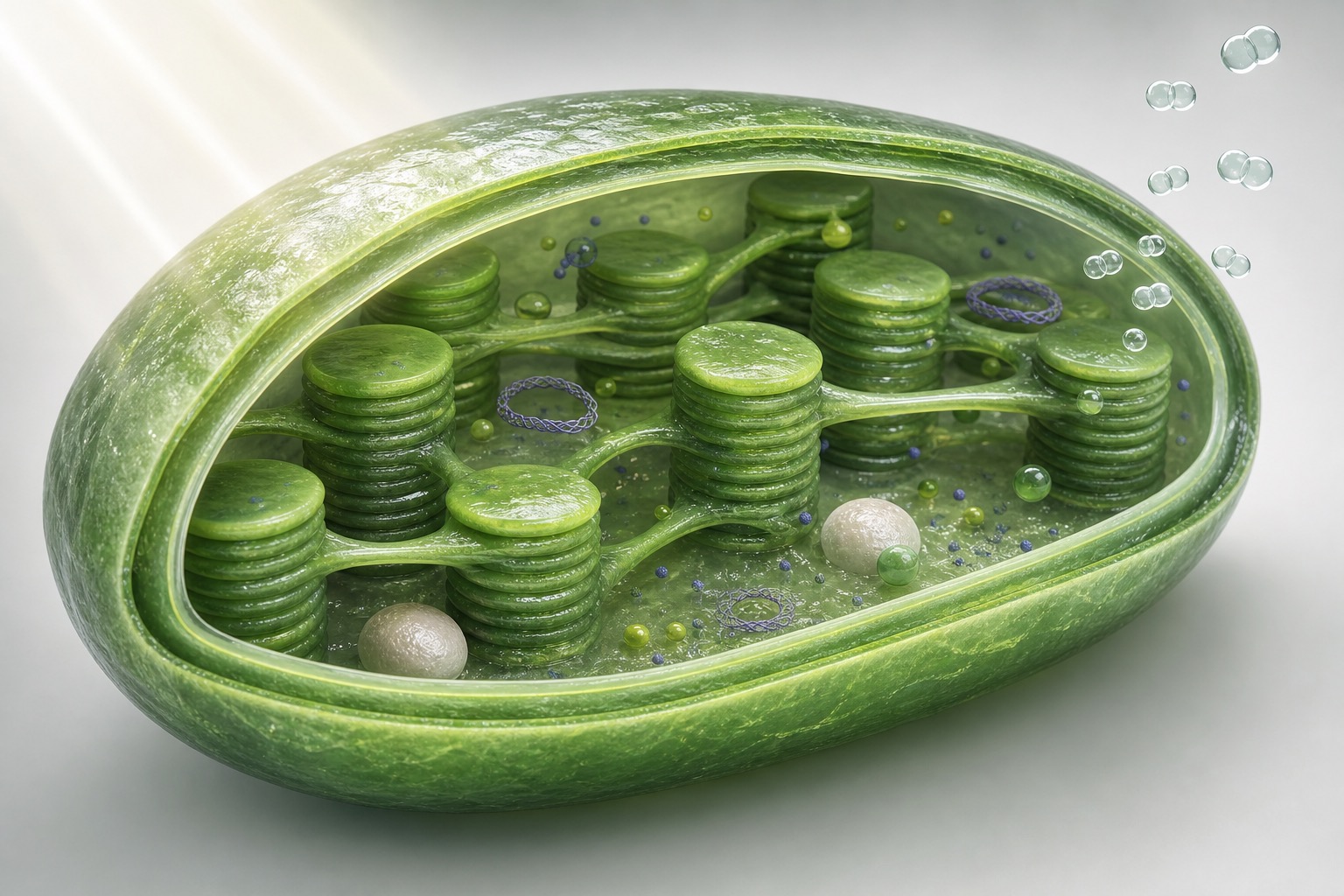
A chloroplastChloroplastA double-membrane organelle in plants and algae where photosynthesis takes place. It contains green chlorophyll and its own small DNA genome. is a lens-shaped organelle, typically 3 to 10 µm long, found in plant and algal cells. Like a mitochondrion it has a double membrane, but it also contains a third membrane system: flattened sacs called thylakoidsThylakoidA flattened, membrane-bound sac that holds chlorophyll and carries out the light reactions of photosynthesis. In chloroplasts thylakoids are stacked; in cyanobacteria they lie free in the cell., stacked into piles called grana. The thylakoid membranes contain the green pigment chlorophyll. The fluid around them is the stroma.
PhotosynthesisPhotosynthesisThe process by which plants, algae, and some bacteria use light energy to turn carbon dioxide and water into glucose and oxygen. happens in two stages:
- Light reactions (thylakoid membranes): chlorophyll absorbs light, splits water, releases oxygen, and produces ATP and an energy-carrying molecule.
- Calvin cycle (stroma): the ATP and energy carriers are used to build sugar from carbon dioxide.
carbon dioxide + water + light → glucose + oxygen
Two organelles that were once bacteria
Mitochondria and chloroplasts are strange organelles. They have their own DNA, their own ribosomes, and a double membrane, and they divide on their own by splitting in two. These are bacterial traits.
The endosymbiotic theoryEndosymbiosisA partnership in which one cell lives inside another. Mitochondria and chloroplasts are thought to descend from free-living bacteria that were engulfed by ancestral cells. explains why: more than a billion years ago, an ancestral cell engulfed an oxygen-using bacterium, but instead of digesting it, the two began to live together. The bacterium became the mitochondrion. Later, a similar partnership with a photosynthetic bacterium gave rise to the chloroplast.
The evidence:
- Both organelles have a circular DNA genome, like bacteria.
- Their ribosomes are more similar to bacterial ribosomes than to the ones in the cytoplasm.
- They are surrounded by two membranes, consistent with an engulfed cell.
- They reproduce by a process like binary fission.
- Gene sequences place them close to certain groups of living bacteria.
Which observation supports the idea that mitochondria were once free-living bacteria?
Which statement about plant cells is correct?
Key takeaways
- ATP is the cell's energy currency: cells spend it to power work and rebuild it from food or light.
- A mitochondrion's inner membrane is folded into cristae, which increases the surface available for making ATP.
- Chloroplasts stack thylakoids into grana and turn light energy into chemical energy stored in sugar.
- Evidence for endosymbiosis: their own circular DNA, bacteria-like ribosomes, double membranes and division by splitting.
Sources
- Biology 2e, Chapter 7: Cellular Respiration (OpenStax) Concepts adapted and rewritten; no text reproduced verbatim.
- Biology 2e, Chapter 8: Photosynthesis (OpenStax) Concepts adapted and rewritten; no text reproduced verbatim.
- Project teaching illustration: chloroplast photosynthesis (AI-generated, stylized)
Last reviewed October 1, 2026