From DNA to Protein
How a gene stored in DNA is copied into RNA and then read by a ribosome to build a protein.
Quick answer: A gene is a stretch of DNA that codes for a protein or a functional RNA. In transcription, RNA polymerase copies the gene into mRNA; in translation, a ribosome reads the mRNA three bases (one codon) at a time and joins amino acids into a protein.
What you will learn
- Describe the structure of DNA and what a gene is.
- Explain transcription and where it takes place.
- Use a codon table idea to read a short mRNA message.
- Explain why all the cells in your body can have the same DNA but different proteins.
The cell's instruction manual
Everything a cell does depends on proteinsProteinA chain of amino acids folded into a specific three-dimensional shape. Proteins do most of the work in cells: building structures, catalyzing reactions, moving molecules, and sending signals.: they build structures, speed up reactions, pump ions, and send signals. The instructions for every protein are stored in DNADNA (deoxyribonucleic acid)The molecule that stores genetic information as a sequence of four chemical bases (A, T, G, C) along a double helix..
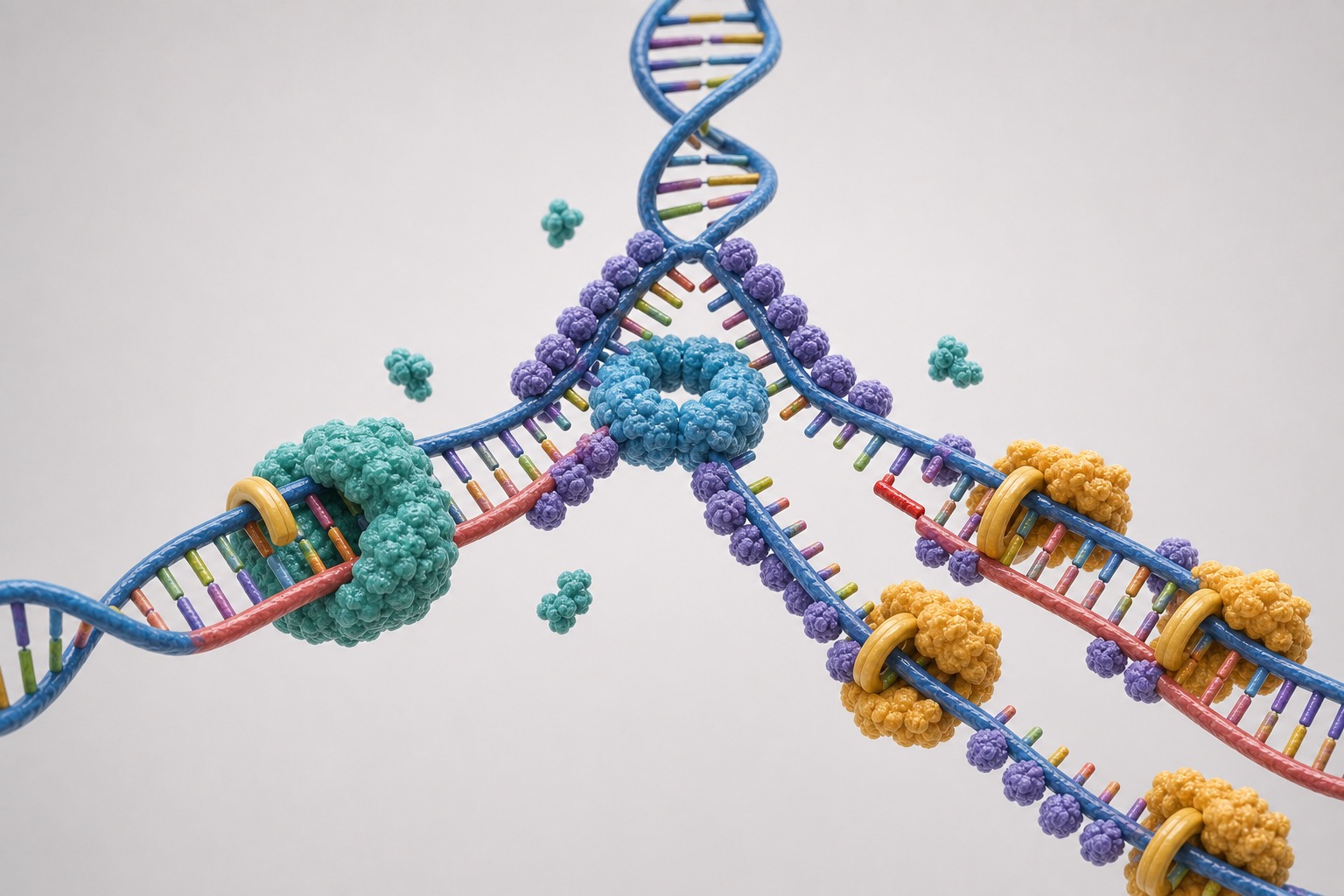
DNA is a double helix, like a twisted ladder. Each rung is a pair of chemical bases: A always pairs with T, and G always pairs with C. The order of bases along one strand is a code, much like the order of letters in a sentence. A geneGeneA stretch of DNA that contains the instructions for making a particular RNA or protein. is a stretch of this code that contains the recipe for a particular RNA or protein. A human cell holds around 20,000 protein-coding genes spread across 46 chromosomesChromosomeOne long DNA molecule packaged with proteins. Human cells have 46 chromosomes. Before division each chromosome is copied and condensed into a visible X shape..
The central dogma
Information moves in one main direction inside cells:
DNA → RNA → protein
The two steps are called transcription and translation.
Step 1: transcription
TranscriptionTranscriptionThe first step of gene expression: an enzyme called RNA polymerase copies a gene's DNA sequence into a messenger RNA. copies a gene into a molecule of RNARNA (ribonucleic acid)A single-stranded nucleic acid that carries or helps carry out genetic instructions. Messenger, transfer, and ribosomal RNA all take part in making proteins.. An enzyme called RNA polymerase attaches at the start of the gene, unzips a short section of the double helix, and builds a matching RNA strand using one DNA strand as a template. RNA differs from DNA in three ways: it is single-stranded, it uses the sugar ribose, and it uses the base U (uracil) in place of T.
The result is a messenger RNAmRNA (messenger RNA)A single-stranded copy of a gene. It carries the instructions from the DNA to the ribosome, where they are read to build a protein. (mRNA), a portable copy of the gene. In eukaryotic cells transcription takes place in the nucleusNucleusThe membrane-bound organelle of eukaryotic cells that holds most of the cell's DNA and is the site where genes are copied into RNA.. The new mRNA is processed (non-coding sections are cut out, a protective cap and a tail are added) and then leaves through a nuclear pore.
Step 2: translation
In translationTranslationThe second step of gene expression: a ribosome reads the codons of a messenger RNA and assembles the matching chain of amino acids., a ribosomeRibosomeA molecular machine made of RNA and protein that reads messenger RNA and links amino acids together to build a protein. It is found in all cells. grabs the mRNA and reads it three letters at a time. Each three-letter group is a codonCodonA group of three nucleotides in messenger RNA that specifies one amino acid (or a signal to stop) during translation., and each codon specifies one amino acid. Adapter molecules called transfer RNAs (tRNAs) bring in the right amino acid for each codon. The ribosome joins the amino acids into a chain, which folds into a finished protein.
The genetic code has a few special codons:
- AUG is the start codon and codes for the amino acid methionine.
- UAA, UAG, and UGA are stop codons. They signal the ribosome to release the finished chain.
There are 64 possible codons but only 20 amino acids, so several codons mean the same thing. The code is nearly universal: bacteria, plants, and humans all read it the same way.
A tiny worked example
Suppose a gene is transcribed into this message:
AUG GCU UAC UAA
Reading it three letters at a time, the ribosome starts at the start codon AUG (methionine), adds the amino acids that GCU (alanine) and UAC (tyrosine) specify, and stops at UAA. The result is a very short chain: Met – Ala – Tyr.
What is the product of transcription?
How many nucleotides make up one codon?
One genome, many cell types
This idea, selective gene expression, is the key to understanding how a single fertilized egg can build hundreds of cell types. You will return to it in lesson 10.
Where does translation take place?
Key takeaways
- DNA is a double helix built from four bases (A, T, G, C); RNA uses U in place of T.
- The central dogma runs DNA to RNA to protein.
- Each codon of three bases specifies one amino acid or a stop signal.
- Cells differ because they switch on different genes, not because they contain different DNA.
Sources
- Biology 2e, Chapter 14: DNA Structure and Function (OpenStax) Concepts adapted and rewritten; no text reproduced verbatim.
- Biology 2e, Chapter 15: Genes and Proteins (OpenStax) Concepts adapted and rewritten; no text reproduced verbatim.
- Project teaching illustration: DNA replication fork (AI-generated, stylized)
Last reviewed October 1, 2026