The Cell Cycle and Mitosis
How a cell copies its DNA, divides it equally between two daughters, and what happens when the controls fail.
Quick answer: The cell cycle runs from interphase (G1, S and G2), when the cell grows and copies its DNA, through mitosis and cytokinesis, which split it into two identical daughter cells. Mitosis has four stages in order: prophase, metaphase, anaphase and telophase.
What you will learn
- List the phases of the cell cycle and say what happens in each.
- Name the four stages of mitosis in order.
- Compare cytokinesis in animal and plant cells.
- Explain how mutations in cell-cycle control can lead to cancer.
Why cells divide
Your body makes millions of new cells every second. They replace those that wear out, repair wounds, and, in a growing child, increase the total number. Each new cell must receive a full and accurate copy of the DNA. The cell does this through a repeating sequence of events called the cell cycleCell cycleThe ordered series of events in a cell's life: a long interphase in which the cell grows and copies its DNA, followed by mitosis and cytokinesis..
The phases of the cell cycle
Most of a cell's life is spent in interphaseInterphaseThe long part of the cell cycle between divisions, when the cell grows, carries out its normal work, and copies its DNA., the long stretch between divisions. Interphase has three parts.
| Phase | Name | What happens |
|---|---|---|
| G1 | First gap | The cell grows and does its normal work. |
| S | Synthesis | The DNA is copied, so each chromosome is duplicated. |
| G2 | Second gap | The cell grows more, checks the copied DNA, and prepares to divide. |
After interphase comes the M phase, in which the cell divides. M phase has two jobs: mitosisMitosisThe part of the cell cycle in which a copied set of chromosomes is separated into two identical nuclei. Its stages are prophase, metaphase, anaphase, and telophase., which splits up the nucleus, and cytokinesisCytokinesisThe final step of cell division, in which the cytoplasm is divided and two separate daughter cells form., which splits up the rest of the cell. A fast-dividing human cell in culture may complete the full cycle in about a day, with mitosis itself taking around an hour. Other cells, such as most neurons, stop cycling altogether.
The stages of mitosis
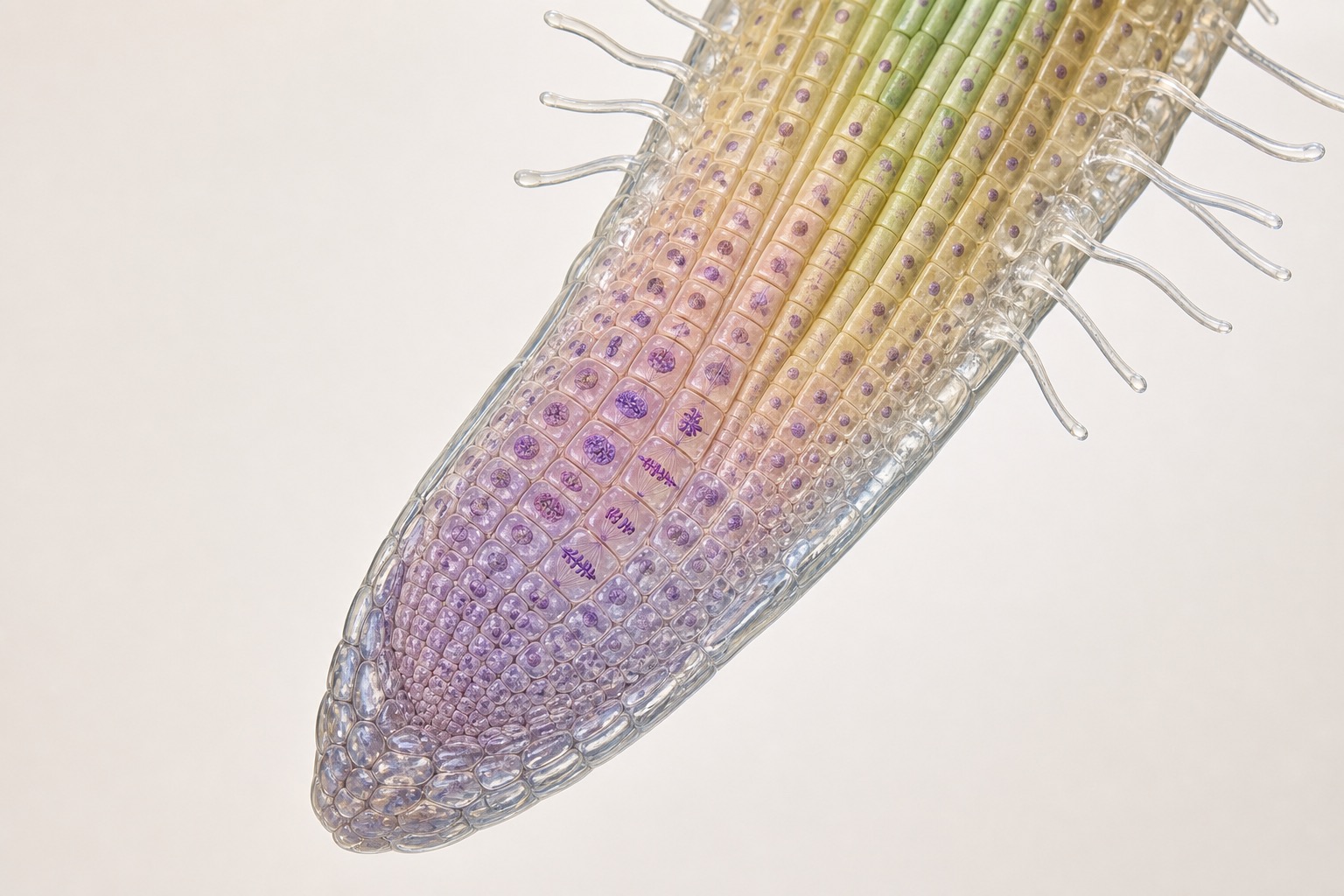
Mitosis is a continuous process, but it is easier to understand as four stages.
- Prophase. The chromatin condenses into visible, X-shaped chromosomesChromosomeOne long DNA molecule packaged with proteins. Human cells have 46 chromosomes. Before division each chromosome is copied and condensed into a visible X shape.. The nuclear envelope breaks down, and a spindle made of microtubulesMicrotubuleA hollow protein tube about 25 nm wide. Microtubules act as tracks for transport, form the mitotic spindle, and make up the core of cilia and eukaryotic flagella. begins to form.
- Metaphase. The chromosomes line up along the middle of the cell, each attached to spindle fibers from both poles.
- Anaphase. The sister chromatids are pulled apart toward opposite ends of the cell. Each is now an independent chromosome.
- Telophase. Two new nuclear envelopes form around the two sets of chromosomes, and the chromosomes relax back into chromatin.
The outcome: two nuclei with identical sets of chromosomes. A human cell starts with 46 chromosomes, and each of the two daughter nuclei ends with 46.
During which phase of the cell cycle is DNA copied?
What happens during anaphase?
Dividing the cytoplasm
Cytokinesis differs between plants and animals.
- In an animal cell, a ring of actin and myosin around the middle tightens like a drawstring, pinching the cell in two. The dent is called the cleavage furrow.
- In a plant cell, the rigid wall prevents pinching. Instead, vesicles gather in the middle and fuse to build a new wall from the inside out. This is the cell plate.
Checkpoints and cancer
Division is risky, so the cycle has built-in checkpoints, where proteins check whether the cell is big enough, the DNA is undamaged, and the chromosomes are properly attached to the spindle. If something is wrong, the cycle halts for repair or the cell is instructed to self-destruct.
CancerCancerA group of diseases in which cells divide without the normal controls, usually because of accumulated changes (mutations) in genes that regulate the cell cycle. develops when mutations break these controls. Two kinds of genes are especially important. Genes that act like an accelerator pedal can become stuck in the "on" position, and genes that act like a brake, such as the well-known p53 gene, can be lost. A cell that has accumulated several such changes ignores the stop signals and divides without control. It is not a single change, but a build-up over time, which is why the risk rises with age.
Meiosis in one paragraph
Cells that make eggs and sperm divide differently, through a process called meiosis. It has two rounds of division and produces four cells, each with half the number of chromosomes. When egg and sperm fuse, the full number of 46 is restored in the fertilized egg. Mitosis keeps the chromosome number the same; meiosis halves it.
Why is cancer described as a disease of lost cell-cycle control?
Key takeaways
- Interphase has three parts: G1 growth, S phase DNA replication and G2 preparation for division.
- The four stages of mitosis are prophase, metaphase, anaphase and telophase.
- Animal cells divide by pinching in a cleavage furrow; plant cells build a cell plate.
- Checkpoints stop damaged cells from dividing, and mutations in the genes that control them can lead to cancer.
Sources
- Biology 2e, Chapter 10: Cell Reproduction (OpenStax) Concepts adapted and rewritten; no text reproduced verbatim.
- Biology 2e, Chapter 11: Meiosis and Sexual Reproduction (OpenStax) Used for the short comparison with meiosis.
- Project teaching illustration: root-tip mitosis (AI-generated, stylized)
Last reviewed October 1, 2026