Paramecium
Single-Celled Protist
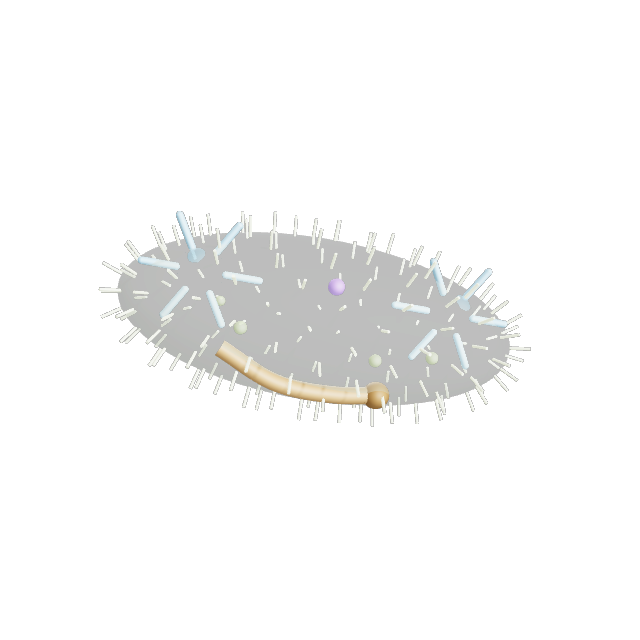
About the Paramecium
Single-Celled Protist
Ponds and freshwater
Paramecia swim through fresh water by beating cilia and feed on bacteria.
Clinical and real-world context
Paramecium is a classic freshwater protist, and it shows how one cell can do the jobs that whole organs do in animals.
4 structures to explore
Cilia
The rowing hairs
Rows of cilia beat in coordinated waves, driving the cell forward and sweeping food into the oral groove.
Paramecium can reverse its cilia when it bumps into an obstacle.
Contractile Vacuole
The water pump
Water constantly enters a freshwater cell by osmosis. Contractile vacuoles collect it through radiating canals and pump it out.
Without the pumps, a freshwater protist would swell and burst.
Oral Groove
The built-in mouth
Cilia sweep bacteria down the oral groove into a gullet, where they are enclosed in vacuoles and digested.
A paramecium can eat thousands of bacteria per day.
Macronucleus and Micronucleus
Two kinds of nucleus
Paramecium keeps a large macronucleus for everyday gene activity and a small micronucleus that exchanges genes during conjugation.
Ciliates are unusual for having two types of nuclei in one cell.