Prokaryotic vs Eukaryotic Cells
The biggest divide in biology is whether a cell keeps its DNA inside a nucleus. Prokaryotes such as bacteria are small and have no membrane-bound organelles; eukaryotes are larger and divide their work among many compartments.
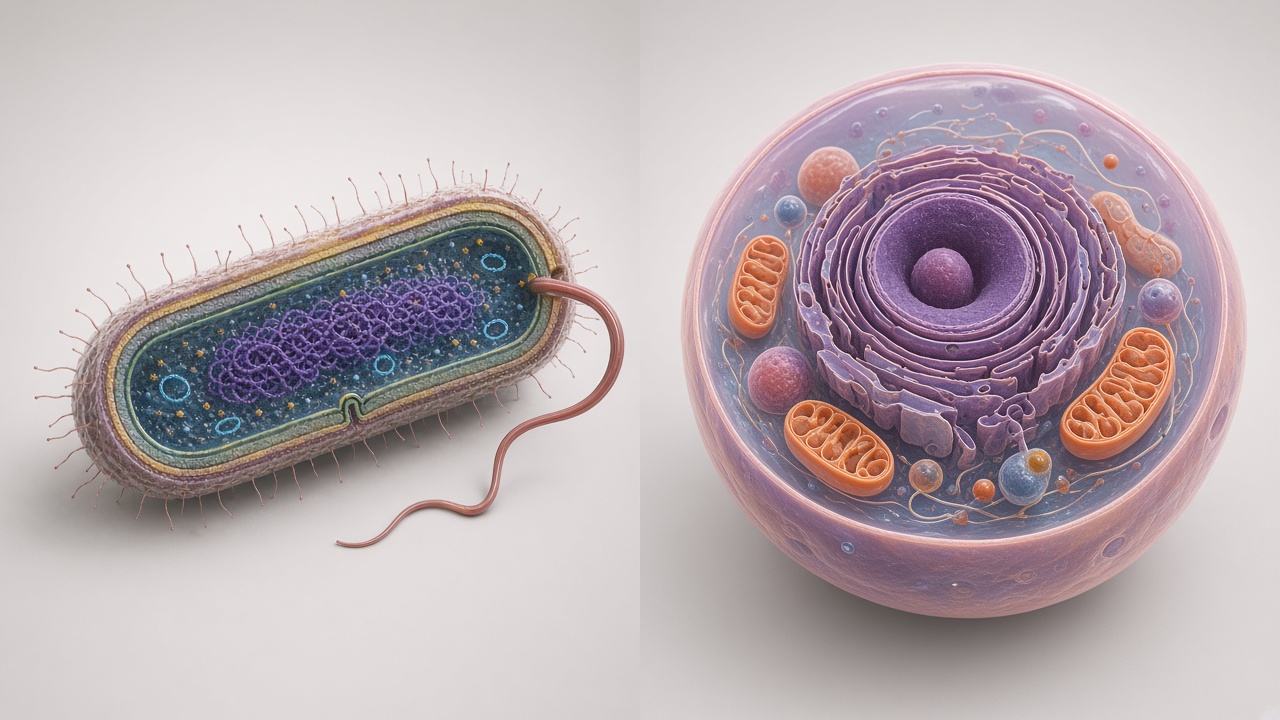
Click a marker or a list item to highlight it.
How they differ
| Feature | Prokaryotic cell | Eukaryotic cell |
|---|---|---|
| Nucleus | None; DNA sits in the nucleoid | Yes, enclosed by a double envelope |
| Membrane-bound organelles | None | Many |
| Typical size | About 1 to 10 micrometres | About 10 to 100 micrometres |
| DNA | Usually one circular chromosome, plus small plasmids | Several linear chromosomes |
| Ribosomes | Smaller | Larger |
| Division | Binary fission | Mitosis followed by cytokinesis |
What both have in common: Plasma membrane, Cytoplasm, Ribosomes, DNA as genetic material
Labelled parts
Key points
- A prokaryote's DNA floats in a region called the nucleoid, with no nuclear envelope around it.
- Eukaryotes have organelles such as mitochondria and the endoplasmic reticulum, each wrapped in membrane.
- Both kinds of cell have a plasma membrane, cytoplasm, ribosomes and DNA.
Check yourself
Where is the DNA of a bacterium kept?
Check yourself
Which feature do prokaryotic and eukaryotic cells both have?
Explanations rewritten in our own words from Biology 2e, Chapter 4: Cell Structure (OpenStax), licensed CC BY-NC-SA 4.0. openstax.org/books/biology-2e/pages/4-introduction