Animal Cell vs Plant Cell
Animal and plant cells are both eukaryotic, so they share a nucleus, mitochondria and a membrane system. A plant cell adds a rigid wall, chloroplasts and a large central vacuole, which together suit it to standing still and making its own food.
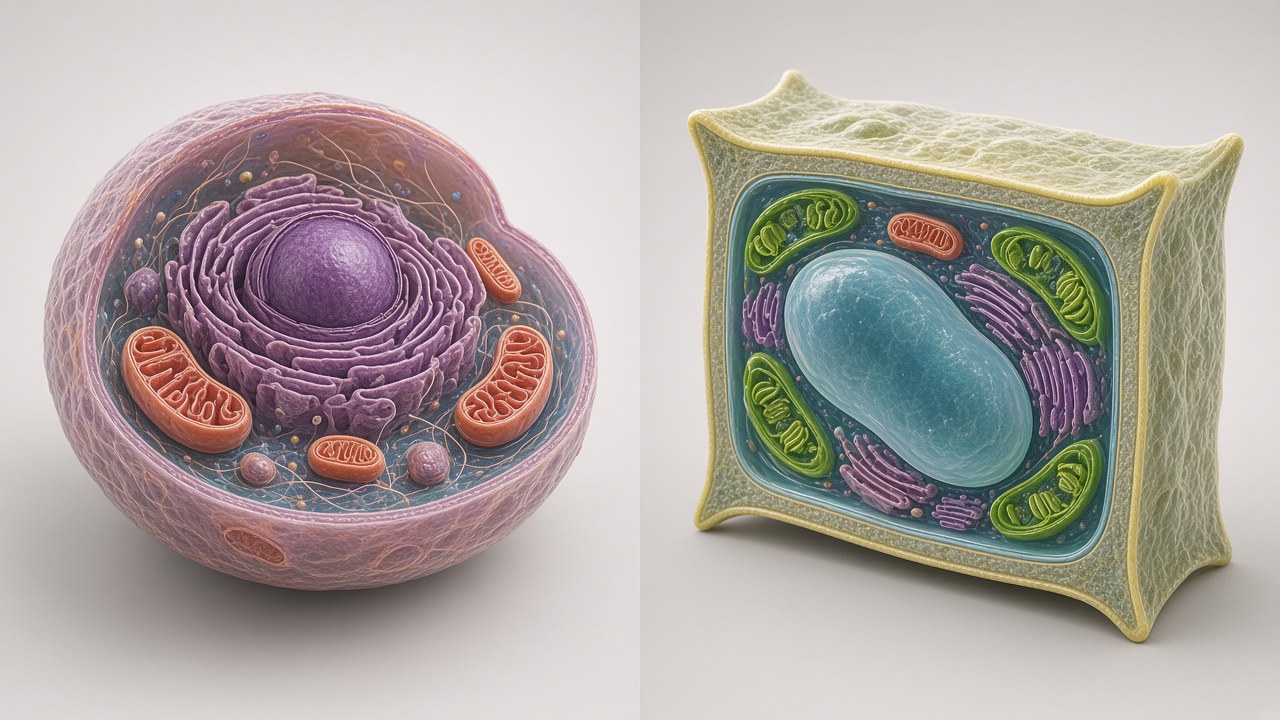
Click a marker or a list item to highlight it.
How they differ
| Feature | Animal cell | Plant cell |
|---|---|---|
| Outer boundary | Plasma membrane only | Cell wall outside the plasma membrane |
| Shape | Round or irregular, can change | Fixed, often box-like |
| Chloroplasts | Absent | Present in green tissues |
| Vacuole | Small and temporary, if any | One large central vacuole |
| Centrioles | Present in the centrosome | Absent in flowering plants |
| Stored sugar | Glycogen | Starch |
What both have in common: Nucleus, Mitochondria, Endoplasmic reticulum, Golgi apparatus, Ribosomes, Plasma membrane
Labelled parts
Key points
- Only plant cells have a cell wall, chloroplasts and a large central vacuole.
- Both cell types have a nucleus, mitochondria, endoplasmic reticulum and a Golgi apparatus.
- Plants make sugar in chloroplasts, yet their mitochondria still burn it for energy.
Check yourself
Which structure is found in plant cells but not in animal cells?
Check yourself
What does the large central vacuole do for a plant cell?
Explanations rewritten in our own words from Biology 2e, Chapter 4: Cell Structure (OpenStax), licensed CC BY-NC-SA 4.0. openstax.org/books/biology-2e/pages/4-introduction