Cell Communication and the Neuron
How cells send, receive, and respond to signals, and how a nerve cell passes a message across a synapse.
Quick answer: Cells communicate by releasing signal molecules that bind receptors on target cells, which turn the signal into a response. A neuron sends an electrical action potential along its axon, then releases neurotransmitters across the synapse to pass the message to the next cell.
What you will learn
- Describe the three stages of cell signaling: reception, transduction, and response.
- Explain why only some cells respond to a given signal.
- Describe how an action potential travels along an axon.
- Outline the steps of chemical transmission at a synapse.
Cells talk to each other
A single cell in a multicellular body needs to know what its neighbors are doing. It must learn when to divide, when to release a hormone, when to contract, and when to die. It does so by exchanging chemical and electrical signals.
Signals can travel in several ways:
- Direct contact. Neighboring cells exchange small molecules through channels in their membranes (gap junctions in animals, and plasmodesmata in plants).
- Local signaling. A cell releases molecules that act on cells nearby.
- Long-distance signaling. Hormones are carried in the blood to targets across the body.
- Synaptic signaling. Neurons release neurotransmitters across a tiny gap onto the next cell.
Receptor, transducer, response
Most signaling follows the same three-stage plan.
- Reception. The signaling molecule, called a ligandLigandA signaling molecule that binds to a specific receptor protein, like a key fitting a lock., binds to a specific receptorReceptorA protein, usually in the plasma membrane, that binds a specific signaling molecule and triggers a response inside the cell. protein, typically on the cell surface. The fit is like a key in a lock.
- Transduction. The receptor changes shape and starts a chain of events inside the cell. This relay is called signal transductionSignal transductionThe chain of steps by which a signal that reaches a receptor at the cell surface is converted into a response inside the cell.. Often a single ligand sets off a cascade in which each step activates many molecules in the next, so a faint signal is amplified into a big response.
- Response. The cell does something: opens an ion channel, turns a gene on or off, changes its shape, or starts to secrete.
Only cells with the right receptor respond to a given ligand. That is how a hormone can travel through the whole body yet change only its target tissues.
What is the correct order of the stages of cell signaling?
The neuron: a cell built for signaling
A dendriteDendriteA branched extension of a neuron that receives signals from other cells and passes them toward the cell body. is a branched extension that receives signals. The cell body (soma) combines them. If the combined input is strong enough, the neuron fires an electrical signal that runs along its axonAxonThe long, thin extension of a neuron that carries electrical signals away from the cell body toward other cells. to the far end.
The action potential
A resting neuron is electrically charged: the inside of the membrane is about 70 millivolts negative compared with the outside. This is the result of the sodium-potassium pump and of channels that let potassium leak out.
When the neuron is stimulated past a threshold, sodium channels open. Sodium ions rush in and the inside briefly becomes positive. This swing is the action potentialAction potentialA brief, self-propagating wave of electrical change along a cell membrane. Neurons and muscle cells use action potentials to carry signals quickly over long distances.. It opens the neighboring channels, which open the next ones, and so the pulse travels down the axon like a row of falling dominoes. A moment later, potassium channels open and the membrane resets.
An action potential is all-or-nothing: it has the same size no matter how strong the stimulus was. Many axons are wrapped in a fatty insulating sheath called myelin, which makes the pulse jump from gap to gap and speeds it to over 100 metres per second.
Crossing the synapse
An axon does not touch the next cell. At the synapseSynapseThe junction where a neuron passes a signal to another cell, usually by releasing neurotransmitters across a tiny gap., a gap about 20 nm wide separates the two. The message must be translated to a chemical one to cross it.
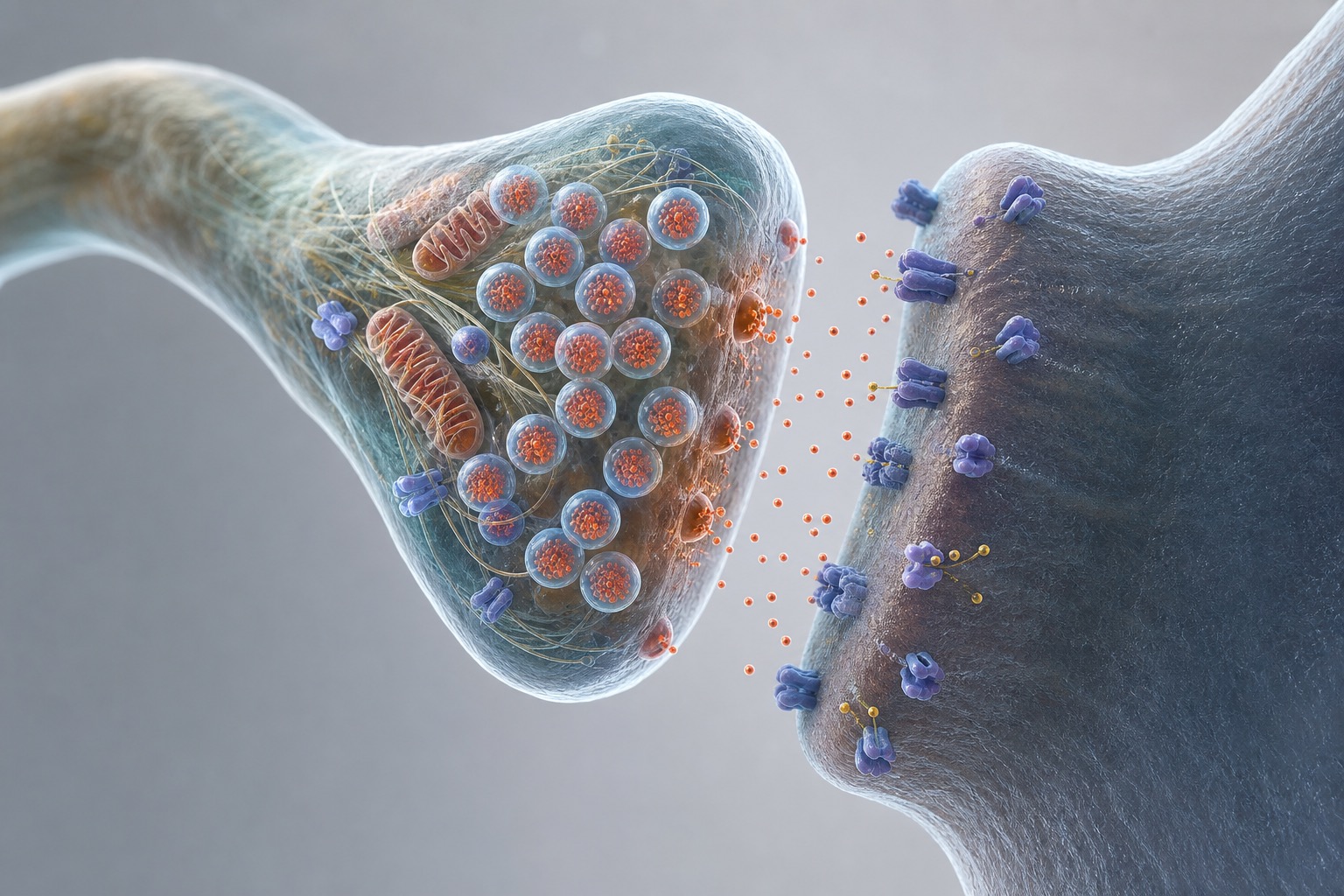
- The action potential reaches the axon terminal and opens calcium channels. Calcium ions flow in.
- The calcium triggers vesicles full of neurotransmitterNeurotransmitterA chemical released by a neuron at a synapse that crosses the gap and binds to receptors on the next cell. to fuse with the membrane and release their contents by exocytosisExocytosisA process in which a vesicle fuses with the plasma membrane and releases its contents outside the cell..
- The neurotransmitter diffuses across the gap.
- It binds to receptors on the next cell, which opens ion channels there. The next cell is either excited or inhibited.
- The neurotransmitter is rapidly removed, either by enzymes that destroy it or by pumps that take it back up, so the signal ends cleanly.
Many medicines and drugs act at this step. For example, some antidepressants slow the re-uptake of neurotransmitters so that they stay longer in the gap.
What triggers synaptic vesicles to release neurotransmitter?
Why does a hormone in the blood affect only certain cells?
Key takeaways
- Only cells that have the matching receptor respond to a given signal.
- Signaling has three steps: receptor, transducer and response.
- An action potential is a wave of ion channels opening that travels along the axon without fading.
- At the synapse, calcium entry makes vesicles release neurotransmitter, which crosses the gap and binds receptors on the next cell.
Sources
- Biology 2e, Chapter 9: Cell Communication (OpenStax) Concepts adapted and rewritten; no text reproduced verbatim.
- NIH 3D: Neuron model
- Project teaching illustration: neuron synapse transmission (AI-generated, stylized)
Last reviewed October 1, 2026